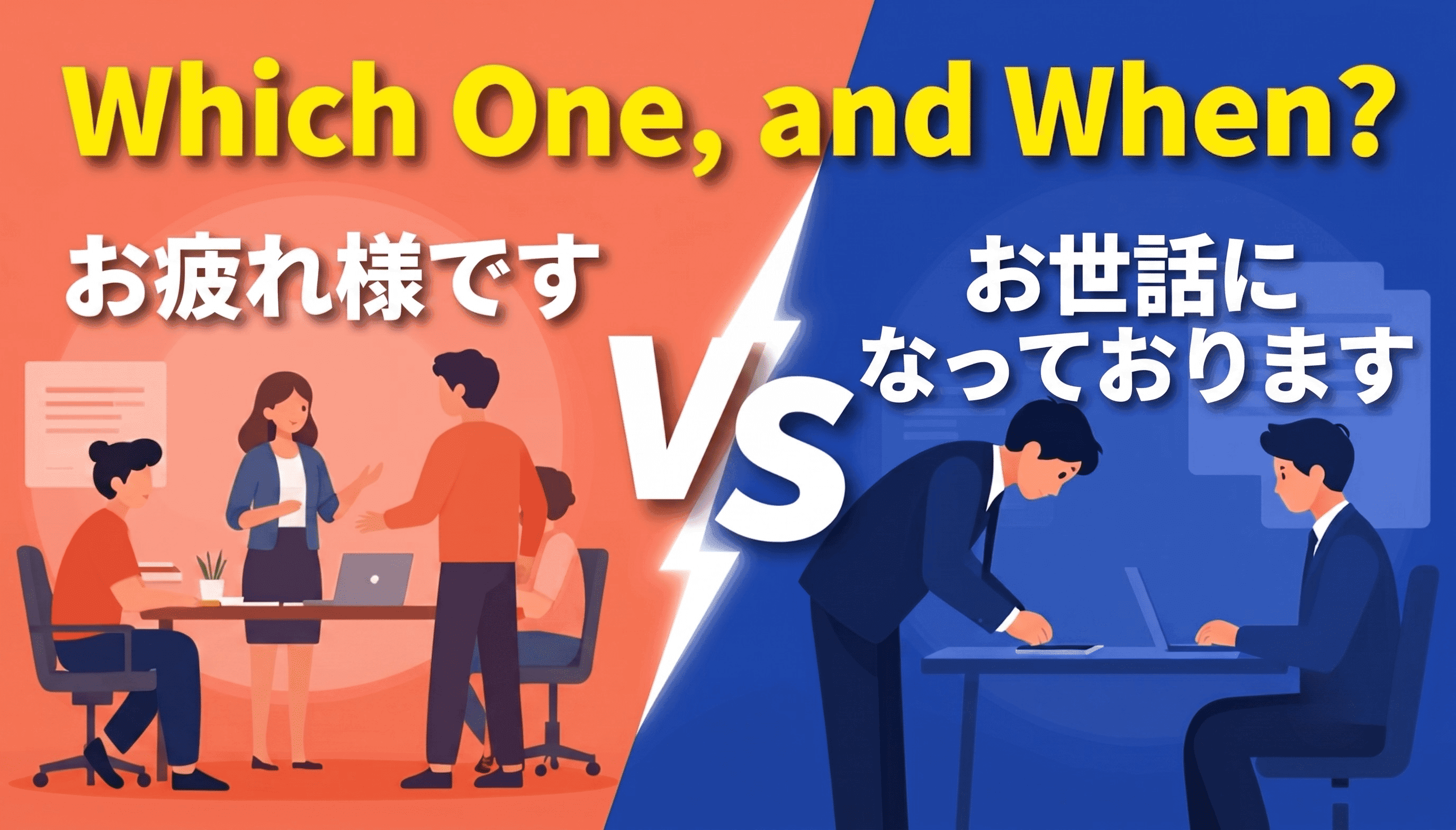
お疲れ様です vs お世話になっております: Which One, and When
One is for people inside your company, one is for everyone outside it. Mixing them up is the fastest way to sound new. Here is the line, with romaji.
These two phrases open more Japanese business messages than anything else, and almost every guide translates them into English mush. お疲れ様です becomes "thank you for your hard work". お世話になっております becomes "thank you for your continued support". Both translations are useless, because neither tells you the only thing that matters: which one to type right now.
Here's the short version. お疲れ様です is for people inside your company. お世話になっております is for everyone outside it. That's the whole rule, and getting it backwards is one of the most visible mistakes a non-native speaker can make, because Japanese colleagues will not correct it and clients will simply notice.
This guide covers the line between the two, the situations where it moves, the third phrase that is never safe upward, and the over-corrections worth skipping.
What you will get from this guide
- お疲れ様です is internal. お世話になっております is external.
- The line is 内 and 外, the same group boundary that governs keigo generally.
- ご苦労様です points downward only and is never safe toward a senior.
- On first contact, お世話になっております is wrong, because nothing has happened yet.
The line is inside versus outside
Japanese sorts people into 内 (uchi, your group) and 外 (soto, outside it), and that boundary decides more than these two greetings. It decides which keigo you use for your own manager when a client is listening. These phrases are just the most visible place it shows up.
お疲れ様です acknowledges shared effort. It only works between people who are on the same side of that line, which is why it belongs at work, among colleagues.
お世話になっております acknowledges an ongoing relationship between two parties. It only makes sense across the line, which is why it belongs in client mail.
Send お疲れ様です to a customer and you have quietly filed them as a coworker. Nobody will say anything. It lands anyway.
What お疲れ様です actually does
It's a greeting, not a thank-you. That's the part the English translation destroys.
You say it when you arrive, when you leave, when you pass someone in a corridor, when you open a Slack message, and when you end a call. It carries no information. It marks that you and the other person are colleagues, in the same way that "morning" does in English without anyone meaning anything about the morning.
お疲れ様です。先ほどの資料をお送りしました。 Otsukaresama desu. Sakihodo no shiryou o ookuri shimashita. Hi. I have sent over the document from earlier.
Two useful properties. It works at any hour, unlike おはようございます (ohayou gozaimasu), which stops being right at some fuzzy point in the morning. And it works upward, sideways and downward inside the company, which makes it the safest internal greeting there is.
What お世話になっております actually does
It opens external mail, and it means something closer to "we have an ongoing relationship" than to any specific thanks.
いつもお世話になっております。株式会社◯◯の田中です。 Itsumo osewa ni natte orimasu. Kabushiki-gaisha marumaru no Tanaka desu. Thank you for your continued business. This is Tanaka from Company X.
いつも (itsumo, always) is standard with regular contacts and can be dropped for occasional ones. The phrase is so expected that leaving it out of a client email reads as abrupt, in the way that starting an English business email with no greeting at all reads as abrupt.
The table
| Who you are writing to | Opening | Romaji |
|---|---|---|
| Colleague, any seniority | お疲れ様です | otsukaresama desu |
| Your own manager | お疲れ様です | otsukaresama desu |
| Client or supplier, ongoing | いつもお世話になっております | itsumo osewa ni natte orimasu |
| Client, occasional contact | お世話になっております | osewa ni natte orimasu |
| Someone you are contacting for the first time | 突然のご連絡失礼いたします | totsuzen no gorenraku shitsurei itashimasu |
| A junior, when thanking them for effort | お疲れ様です | otsukaresama desu |
That last row deserves its own section, because there is a phrase people reach for there instead, and it is a trap.
ご苦労様です points downward only
「ご苦労様です」 (gokurousama desu) also translates as "thank you for your hard work". It carries a direction that お疲れ様です does not: it comes from above and lands below.
Say it to your manager and you have inverted the hierarchy in a single word. Say it to a client and it is worse.
The safe rule is simple. Don't use it. お疲れ様です covers every case where you were tempted, including downward, and it never backfires. There are companies where ご苦労様です flows freely between peers, but you do not want to be the person testing that hypothesis on their third week.
First contact is the exception
お世話になっております assumes a relationship already exists. On a genuine first approach, it claims something untrue, and Japanese readers hear that immediately.
| Situation | Opening | Romaji |
|---|---|---|
| Cold outreach | 突然のご連絡失礼いたします | totsuzen no gorenraku shitsurei itashimasu |
| Introduced by someone | ◯◯様よりご紹介いただきました | marumaru-sama yori goshoukai itadakimashita |
| Second message onward | お世話になっております | osewa ni natte orimasu |
By the second exchange, switch. Continuing to open with 「突然のご連絡失礼いたします」 after they have replied is its own kind of odd.
Over-corrections worth skipping
お疲れ様でございます (otsukaresama de gozaimasu). Grammatically fine, and mostly unnecessary. It appears when someone wants extra respect for a senior, but the phrase is already an internal greeting, and pushing it up a level mainly signals that you are anxious about rank. Some companies use it as house style. If yours does not, plain です is correct.
Stacking both. Opening a client email with お疲れ様です and then お世話になっております does not double your politeness. It reads as someone who could not decide.
お疲れ様 without です. Fine downward and among close peers, and too casual upward. The です is doing real work.
Where to go from here
The rule is one line, and applying it under pressure means knowing which side of the boundary each person is on, which changes with the room. A client on the thread makes your own department head external. That is the part worth understanding properly.
The complete keigo guide covers 内 and 外 in full, including what happens to your manager's name when a customer is reading. Once the greeting is settled, asking for something without sounding like an order handles the sentence that usually comes next.
Veltone reads the recipient before it writes the greeting. Tell it who the message is going to, and the opening, the closing and the request all come out on the same side of the line, with notes on the phrases it highlights.
Get the tone right, every time.
No credit card required. Start with three translations a day.
You may also like
 japanese, keigoHow to Ask for Something in Japanese Without Sounding Like an Orderください comes from an imperative, so ご確認ください is closer to "check this" than to "please check." Here is the request ladder, with romaji.
 japanese, keigoThe Keigo Mistakes Even N1 Holders MakeThe JLPT has no speaking or writing section, so N1 certifies reading and listening. Here are the keigo errors that survive it, and two that are not errors.
 japanese, keigoJapanese Keigo: The Complete Guide for ProfessionalsKeigo has five categories, not the three most guides teach. Here is what each one does, the group rule that overrides rank, and a verb table with romaji.