The Keigo Mistakes Even N1 Holders Make
The JLPT has no speaking or writing section, so N1 certifies reading and listening. Here are the keigo errors that survive it, and two that are not errors.
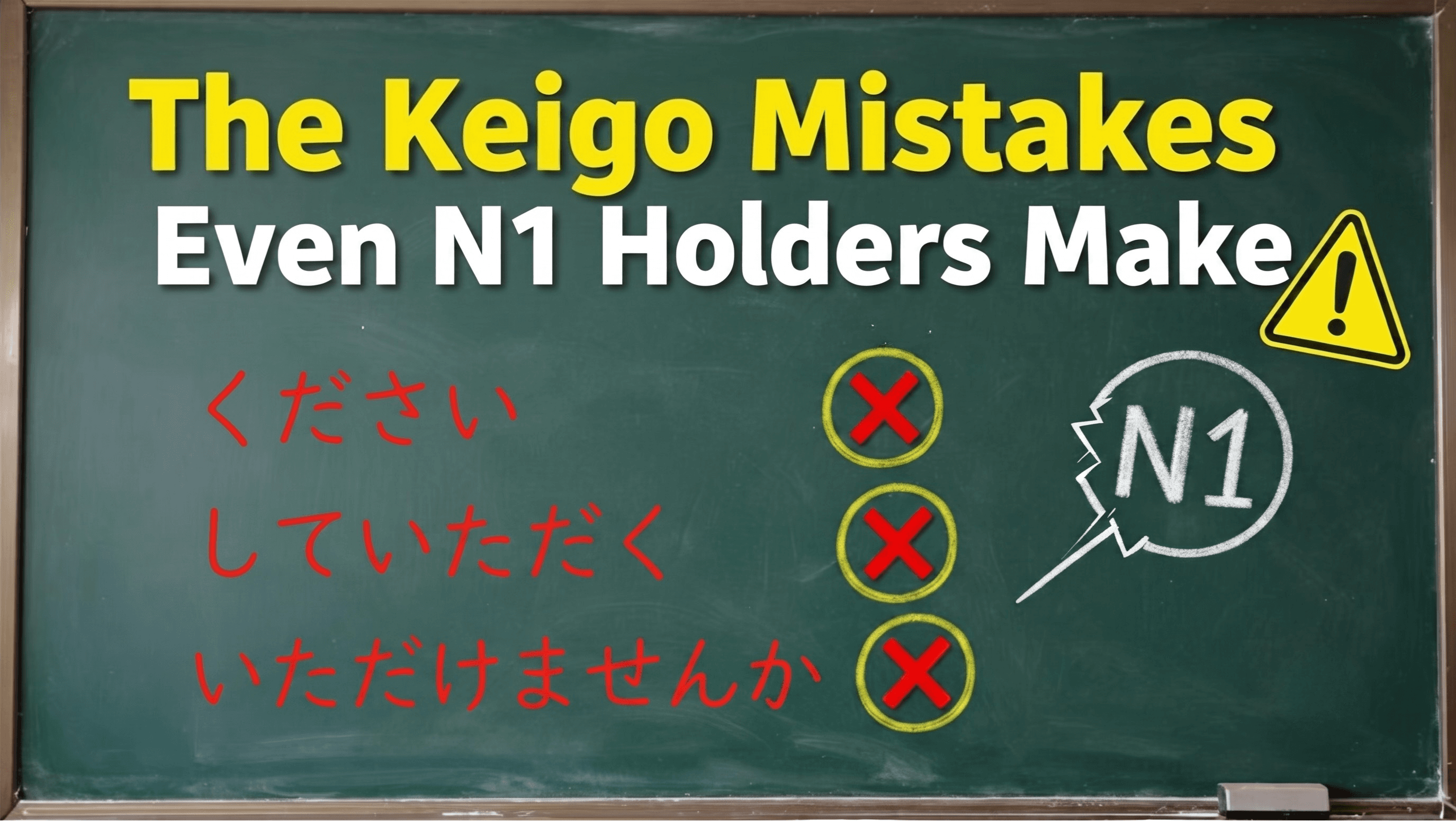
If you hold N1 and still freeze before sending a client email, nothing has gone wrong with you. Look at what the test actually measures.
N1 has two sections: Language Knowledge with Reading, and Listening (JLPT, Composition of Test Sections and Items). There is no speaking section and no writing section, at any level. The certificate says you can understand difficult Japanese. It was never designed to say you can produce it, and keigo is almost entirely a production problem.
So here are the mistakes that survive N1, why each one happens, and two things you may have been told are errors that aren't.
What you will get from this guide
- The JLPT tests reading and listening only, so production is untested at every level.
- The recurring errors are structural: wrong direction, doubled forms, wrong group.
- 「ご確認していただく」 is broken. 「ご確認いただく」 is correct.
- 「とんでもございません」 and 「了解しました」 are treated as errors more harshly than the evidence supports.
What N1 certifies, and what it does not
Reading and listening are recognition skills. You see a form, you match it to a meaning. Keigo recognition is genuinely easy at N1 level, and most holders can identify 尊敬語 (sonkeigo) and 謙譲語 (kenjougo) in a passage without effort.
Production runs the other way. You start from a relationship and a situation, and you have to select a form. Nothing on the test rehearses that, which is why the gap between certificate and inbox feels so wide. It isn't a gap in your Japanese. It's a gap in what got measured.
The mistakes, at a glance
| Mistake | Wrong | Right |
|---|---|---|
| Honorific on yourself | 私が おっしゃいました | 私が 申しました |
| Doubled sonkeigo | お読みになられる | お読みになる |
| Wrong humble category | 大阪に伺います | 大阪に参ります |
| Group boundary ignored | 田中部長がおっしゃっています | 弊社の田中が申しております |
| Prefix plus して | ご確認していただく | ご確認いただく |
| Manual keigo | 資料のほうになります | 資料でございます |
Each one is worth understanding rather than memorising, because the underlying logic repeats.
Pointing an honorific at yourself
尊敬語 raises the person you are describing. Use it for your own actions and you have raised yourself, which reads as either confused or arrogant depending on how charitable the reader feels.
私が申しました。 Watashi ga moushimashita. I said it.
Almost everyone does this once. It usually happens under pressure, in speech, when the honorific form is the one that comes to hand first.
Doubling the same category
Stack two markers from one category on a single verb and you have 二重敬語 (nijuu keigo). 「お読みになられる」 (oyomi ni narareru) uses お〜になる and られる, and both are 尊敬語.
お読みになる。 (correct) お読みになられる。 (doubled)
Japan's Agency for Cultural Affairs treats this as generally inappropriate while noting that some doubled forms have settled into ordinary use, 「お伺いする」 (oukagai suru) among them (文化庁, 報告・答申・建議等). Follow the rule, and hold it loosely where usage has already moved.
Mixing the two humble categories
This is the error most invisible to N1 holders, because the three-category model taught in most classrooms cannot express it.
謙譲語I lowers your action toward a specific person. 謙譲語II, also called 丁重語 (teichougo), is formality toward your listener with nobody in particular being lowered.
御社に伺います。 (kenjougo I: you are going to that specific company) 大阪に参ります。 (kenjougo II: Osaka is a place)
Say 「大阪に伺います」 and you have politely implied that Osaka outranks you. The forms that live in category II are 参る, 申す, いたす and おる, and they are exactly the ones most textbooks file next to 伺う and 申し上げる as if they were interchangeable.
Ignoring the group boundary
Inside your company, your department head takes 尊敬語. Speaking to a client about that same person, you and your manager are both 内 (uchi), the client is 外 (soto), and your manager takes humble forms. The title comes off too.
弊社の田中が申しております。 Heisha no Tanaka ga moushite orimasu. Tanaka at our company says...
「田中部長がおっしゃっています」 to a customer is grammatically perfect and socially backwards. This one survives N1 more reliably than any other error on the list, because the rule it violates is rarely stated in English-language materials at all.
The prefix that does the work twice
ご確認いただけますでしょうか。 (correct) ご確認していただけますでしょうか。 (broken)
The ご prefix already builds the humble construction. Adding して duplicates it. Both 「ご確認いただく」 and 「確認していただく」 are fine on their own, and the hybrid is not. It appears constantly in otherwise strong business Japanese, including from native speakers.
Manual keigo
マニュアル敬語 (manyuaru keigo), sometimes called バイト敬語, is the speech style absorbed from part-time service work. It spreads because it sounds elaborate.
| Pattern | Instead |
|---|---|
| 資料のほうになります | 資料でございます |
| こちらでよろしかったでしょうか | こちらでよろしいでしょうか |
| 千円からお預かりします | 千円お預かりします |
「〜のほう」 hedges a noun that needs no hedging. 「よろしかった」 puts a present question in the past. Neither is catastrophic, and both mark the speaker as having learned politeness from a shift manual rather than from an office.
Two things that are not the errors you were told
とんでもございません
You may have been taught that this is broken, on the grammatical argument that とんでもない is a single adjective and cannot be split. The Agency for Cultural Affairs addresses the phrase directly and treats it as acceptable in modern usage, while noting 「とんでもないことでございます」 as the more traditional form.
Use either. What you should not do is correct a Japanese colleague who says it.
了解しました
Business manner books widely instruct juniors to use 「承知しました」 (shouchi shimashita) upward and reserve 「了解しました」 (ryoukai shimashita) for peers and juniors. That instruction is recent, and it is a convention of manner guides rather than a rule with a grammatical basis.
Practically: follow it. The expectation is real in most Japanese companies, and being right about etymology is worth very little when the reader has already formed an impression. Just know that you are following an office convention, not fixing an error, which matters when you meet a workplace that does not share it.
Where to go from here
Every mistake on this list is structural. Direction, category, group, doubling. None of them is a vocabulary gap, which is why more study of the kind that got you to N1 will not close them, and why hitting them repeatedly feels so disproportionate to your actual level.
The complete keigo guide covers the five official categories and the group rule in full. For the pattern that produces the most daily friction, asking for something without sounding like an order goes through the request ladder.
Veltone highlights the phrases doing the social work in what it writes and explains what each one is doing, on your own messages, in your own situations. That is the repetition the test never gave you.
Get the tone right, every time.
No credit card required. Start with three translations a day.
You may also like
 japanese, keigoHow to Ask for Something in Japanese Without Sounding Like an Orderください comes from an imperative, so ご確認ください is closer to "check this" than to "please check." Here is the request ladder, with romaji.
 japanese, keigoお疲れ様です vs お世話になっております: Which One, and WhenOne is for people inside your company, one is for everyone outside it. Mixing them up is the fastest way to sound new. Here is the line, with romaji.
 japanese, keigoJapanese Keigo: The Complete Guide for ProfessionalsKeigo has five categories, not the three most guides teach. Here is what each one does, the group rule that overrides rank, and a verb table with romaji.