Why Tone Matters More Than Accuracy in Japanese Business
Your Japanese might be grammatically perfect — but if the tone is wrong, your message can damage relationships. Here's why tone is the real challenge in Japanese business communication.
Veltone Team
March 17, 2026
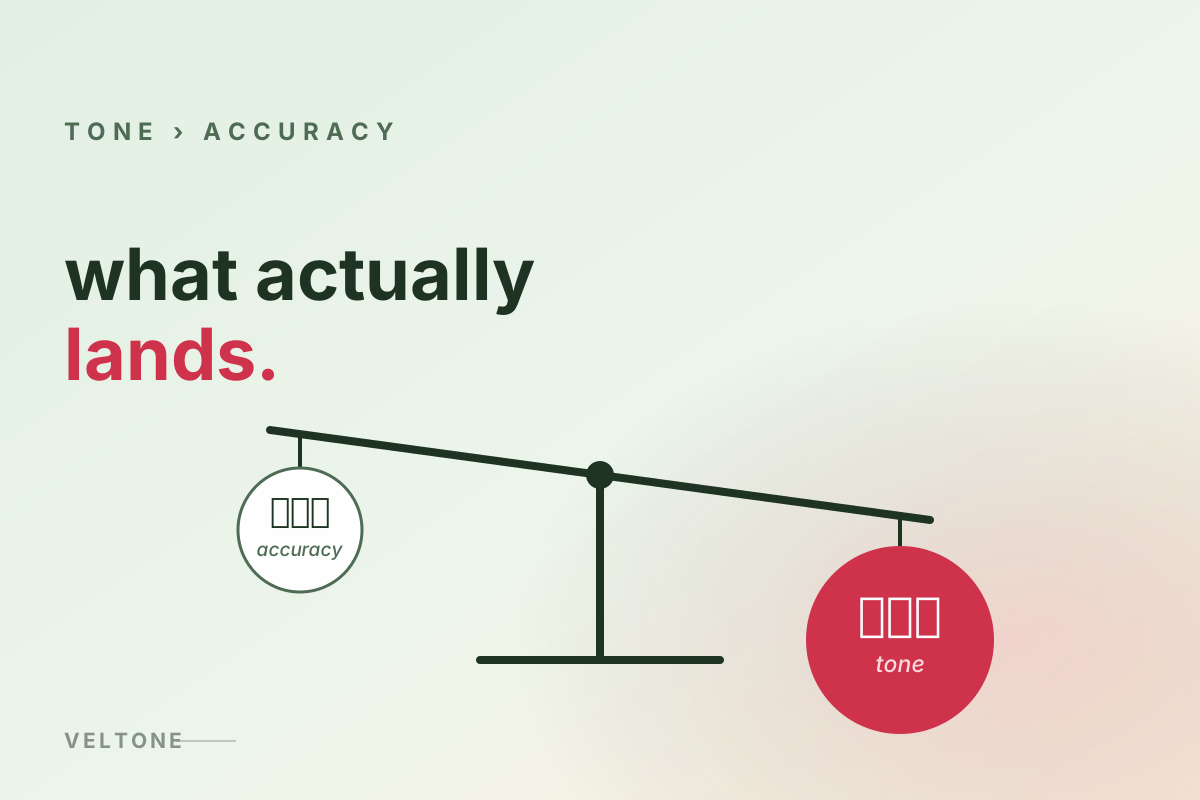
The Email That Said All the Right Words — and Still Failed
Imagine this: you've just closed a promising meeting with a Japanese client. Back at your desk, you draft a follow-up email in English, run it through a translator, and hit send. The grammar is flawless. Every word is correct.
But the reply is unusually short. The warmth from the meeting is gone. You re-read your email three times. Nothing seems wrong.
Except everything is.
The problem isn't what you said — it's how you said it. In Japanese, tone isn't decoration. It's the message.
Why Japanese Has a Formality System English Doesn't
English has informal and formal registers, but they're mostly optional. You can email your CEO and a college friend using roughly the same sentence structure. The words might change, but the grammar stays the same.
Japanese is fundamentally different. It has a built-in formality system called keigo (敬語) — a set of grammatical rules that encode your relationship with the reader, your relative social positions, and the context of the conversation.
Keigo has three distinct layers:
- 尊敬語 (sonkeigo) — Respectful language that elevates the other person's actions. Used when describing what a client or superior does.
- 謙譲語 (kenjougo) — Humble language that lowers your own actions. Used when describing what you do for someone above you.
- 丁寧語 (teineigo) — Polite language (the familiar です/ます endings). The baseline for professional conversation, but not the ceiling.
Most Japanese learners only study teineigo. That's the equivalent of learning how to dress business casual — it works for the office, but it's not what you wear to meet the CEO of your biggest client.
Keigo isn't a nice-to-have. It's structural. A sentence without the right keigo level doesn't just sound "casual" — it can sound disrespectful, presumptuous, or tone-deaf.
This is what catches most non-native speakers off guard. You can study Japanese for years, pass the JLPT N1, and still send an email that makes a client uncomfortable — not because your grammar is wrong, but because your tone is.
Same Words, Different Worlds
Consider a simple request: "Could you check this document?"
In English, that sentence works in almost any context. In Japanese, the translation changes dramatically depending on who you're writing to:
To a close colleague:
これ確認して!
Short, direct, particles dropped. This is casual Japanese (タメ口) — perfectly fine between peers who know each other well.
To a team member you respect:
ご確認いただけますか?
Polite form (丁寧語) with an honorific prefix on "confirm" and a request pattern that softens the ask. This is the everyday professional default.
To a manager or senior colleague:
お忙しいところ恐れ入りますが、ご確認いただけますでしょうか。
Now there's a cushion phrase (恐れ入りますが — "I'm sorry to trouble you"), double-polite verb endings (いただけますでしょうか), and an acknowledgment of the reader's time.
To a client executive you've just met:
誠に恐縮ではございますが、ご確認いただけますと幸いに存じます。
Maximum keigo — layered humility markers (恐縮ではございますが), elevated request form (幸いに存じます), and the kind of language that signals deep awareness of the relationship. This is the register Japanese professionals use to build trust in high-stakes moments.
Same meaning. Four completely different sentences, each with different grammar, vocabulary, and social signal. Send the first version to a client, and you've just undermined weeks of relationship building.
The Real Cost of Getting Tone Wrong
In English-speaking business culture, a slightly informal email is usually forgiven. In Japanese business culture, tone mistakes carry weight — and the consequences compound silently.
Lost trust with clients
A too-casual email to a new business partner signals that you don't understand — or don't respect — the relationship. Japanese professionals rarely correct your tone directly. They just pull back.
Here's what that looks like in practice: you email a prospective client using standard polite Japanese (ご確認ください — "please check this"). The grammar is correct. But the client expected a softer, more deferential request — something like ご確認いただけますと幸いです ("I would be grateful if you could check this"). The difference is subtle in translation, but in the original Japanese, it's the difference between a request and a near-command.
The client doesn't write back to correct you. They respond with a shorter, cooler email. The next meeting gets postponed. Eventually, the deal stalls — and nobody tells you why.
Stalled career progression
If you work in a Japanese company, your internal emails and Slack messages are constantly signaling your awareness of hierarchy. Colleagues notice when your keigo is off, even if they don't say anything.
A foreign employee who uses polite-but-flat Japanese to a department head won't get fired. But they won't get invited to the pre-meeting (根回し — nemawashi) where the real decisions happen. They'll be described as "still learning" (まだ勉強中) — code for "not ready for client-facing roles."
Awkward meetings
Using textbook polite Japanese in a room full of executives who expect formal keigo creates a subtle but unmistakable discomfort. You might not get corrected, but you'll be remembered as someone who "doesn't quite get it."
One telling sign: after your presentation, questions get redirected to your Japanese colleague instead of to you. Not because your content was wrong — because your delivery signaled that you might not navigate a live Q&A at the right formality level.
Over-formality creates distance too
Using maximum keigo with a friendly colleague can create unnecessary barriers. If your teammate says お疲れ様です (standard workplace greeting) and you respond with お疲れ様でございます (elevated version), you're signaling "I don't consider us close enough to relax." They'll keep conversations shorter and more guarded.
The pattern is clear: tone mistakes in Japanese aren't grammar mistakes — they're relationship mistakes. And they work in both directions.
Why Most Translation Tools Miss This
Standard translation tools — even very good ones — typically output Japanese in a single register: polite (丁寧語). That's the safest default, and it works for generic content.
But business communication isn't generic. You're writing to specific people in specific contexts:
- An apology to a client requires formal keigo with layered cushion phrases
- A project update to your manager needs respectful indirectness without being stiff
- A Slack message to your team needs polite-but-approachable phrasing
- A cold outreach email to a new contact requires maximum deference
Most translators don't ask who you're writing to. They don't ask what channel you're using. They don't know if this is your first email to someone or your hundredth.
They give you one output and call it done.
That's like having a wardrobe with only one outfit. It might be a nice outfit, but it's wrong for half the occasions you need it for.
The more you use Japanese professionally, the more you realize: accuracy is table stakes. Tone is what separates "technically correct" from "naturally fluent."
What Tone-Aware Translation Looks Like
This is the gap that Veltone was built to close. Instead of producing a single translation, it asks the two questions that matter most: who are you writing to? and how are you reaching them?
Set the tone to Business for an email to your manager, and the output includes appropriate cushion phrases, humble verb forms for your own actions, and the right closing expression. Switch to Friendly for a Slack message to your team, and those same phrases drop away — replaced by the casual, particle-light Japanese that colleagues actually use with each other.
Every translation also explains why specific keigo choices were made — which verb form was used and what it signals. Over time, the patterns stop feeling foreign. You start anticipating the right register before you even type.
Tone Is Not Optional
If you're communicating in Japanese for work — whether you're emailing clients in Tokyo, messaging teammates on Slack, or preparing for a meeting — tone is the foundation of everything.
Grammar gets your message across. Tone gets your message received.
The good news: you don't have to master keigo overnight. You just need a way to match your intent — the relationship you want to build, the respect you want to convey — to the Japanese that expresses it naturally.
Try Veltone free → and see how the right tone transforms your Japanese.
Want to go deeper? Read our Complete Guide to Japanese Keigo for Professionals or learn about the 5 Japanese Email Mistakes That Cost Foreigners Promotions.
Get the tone right, every time.
Try Veltone free — no credit card required.
keep reading